Chinese researchers have developed a new method for 3D printing ceramics without the need for support structures, enabling the direct creation of complex shapes in mid-air. This represents a significant advance in additive manufacturing for ceramics, removing a long-standing limitation of traditional 3D printing processes.
Ceramics are hard, wear-resistant materials used in electronics, mechanical engineering, aerospace, and other high-performance sectors because they maintain strength at high temperatures and resist wear. However, their inherent brittleness and stiffness make it challenging to produce complex shapes using standard shaping methods and to prevent breakage during fabrication. With standard ceramic 3D printing, support structures are needed to hold overhanging or angled features in place until the material has hardened. Removing those supports later adds time, cost, and the risk of damaging the part.
Mid-Air 3D Printing Changes How Ceramic Parts Are Made
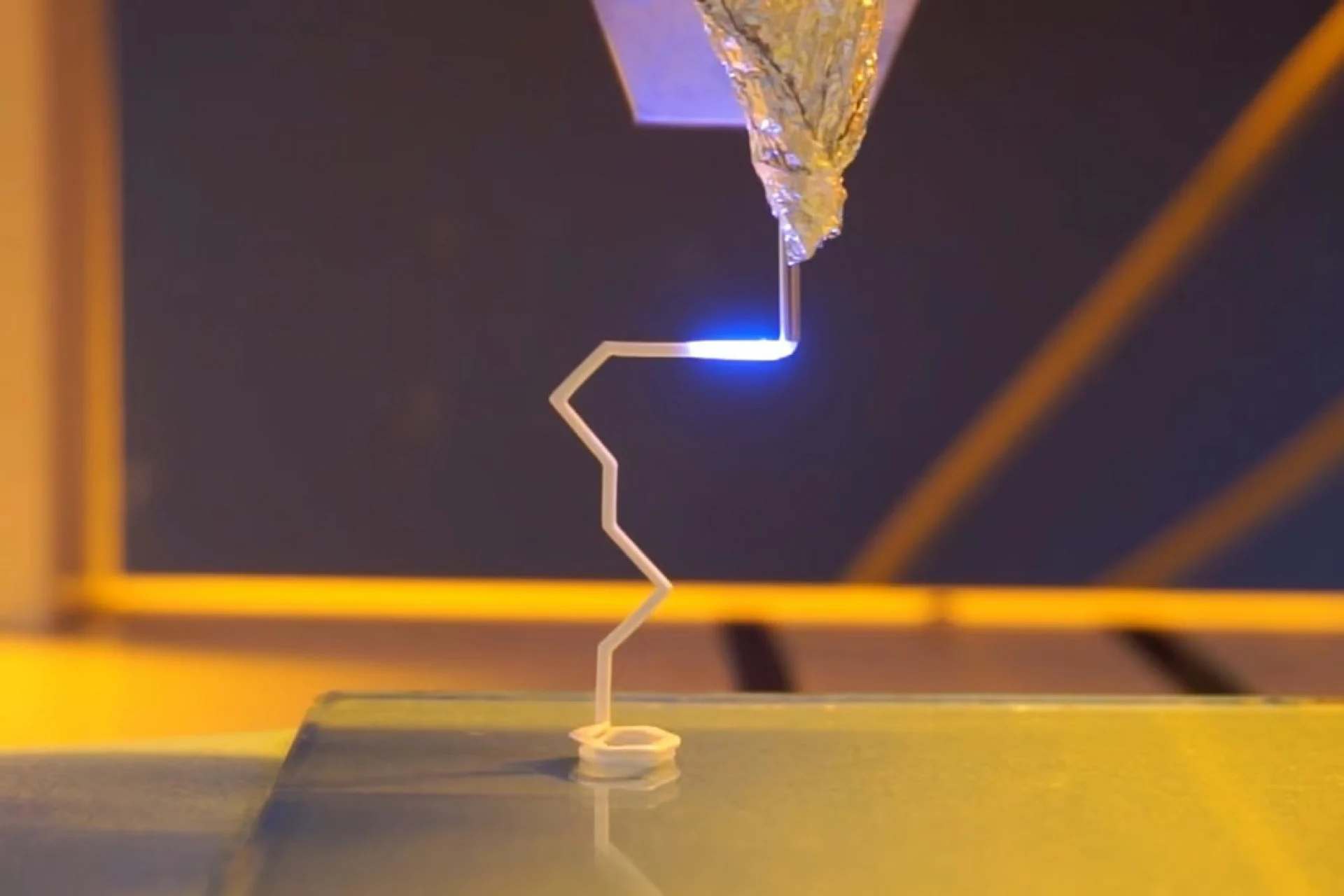
The breakthrough comes from Professor Liu Ren’s team at Jiangnan University in China, who reported the method in the peer-reviewed journal Nature Communications. Their approach is a combination of a specially formulated printing paste and a fast-curing process that activates as the material is printed, allowing unsupported shapes to hold themselves. Technology is a photosensitive ceramic slurry. This paste is not like ordinary ceramic clay; it contains particles that respond instantly to near-infrared (NIR) light during printing. When the ceramic mix is extruded from the printer nozzle, a controlled NIR light source immediately triggers solidification. This instant hardening gives the freshly laid filament mechanical strength right away, so it can support itself in space without collapsing.
A critical technical aspect is the size range of the printed filaments between roughly 0.41 mm and 3.5 mm in diameter. Within this range, the material cures fast enough that features like cantilevered beams and torsion springs can be printed horizontally or at steep angles without sagging or dropping. This contrasts with typical ceramic printing, where unsupported overhangs will warp or break before they cure.
The NIR curing process also penetrates deeper than ultraviolet (UV) light commonly used in photopolymer 3D printing. Tests showed that curing depth under NIR is far greater in much shorter exposure times than UV light, meaning parts gain strength quickly and reliably as they are deposited. This rapid solidification process is crucial for enabling mid-air printing.
Another significant feature of this method is its material flexibility. By adding different ceramic additives like iron oxide (iron red), chromium green, or yttria-stabilized zirconia, the researchers were able to adjust the composition of the printing paste. These additives help unify sintering temperatures when mixing ceramics with different thermal behaviors, broadening the range of ceramic combinations and applications possible with this technique.
Removing the need for supports yields several advantages beyond just cleaner prints. It reduces material use, cuts down on printer time, and eliminates post-processing steps such as support removal and sanding or grinding. In traditional methods, support removal can risk damaging delicate features or leaving marks that weaken the final part. In contrast, unsupported printing delivers parts closer to their finished form straight off the printer. The printed ceramic parts produced with this new technology can still go through typical sintering (a high-temperature densification step that gives ceramics their final mechanical properties). Early demonstrations included torsion springs and complex curved beams that remained stable through printing and subsequent thermal processes.
In practical terms, this development opens up new possibilities for industrial and engineering uses where ceramics’ strength and heat resistance allow complex geometries, such as turbine components, aerospace structures, and advanced electronic housings. By removing the support structure requirement, designers can explore shapes and internal features that were previously impractical or prohibitively expensive to manufacture.
link